reverse -- Reverse engineering functions
segmentation(mesh, tolerance=5, sharp=0.2)

Surface segmentation based on curvature.
This functions splits faces into groups based on curvature proximity.
Ideally each resulting group is a set of faces with the same curvature. In practice such is not possible due to the mesh resolution introducing bias in curvature estimation. Thus a tolerance is used to decide what is a sufficiently close curvature to belong to the same group.
In order to avoid too sharp edges to be considered a very low resolution but smooth surface, sharp is the value of the limit edge angle that can be considered in smooth surface.
This function is particularly usefull when importing geometries from a format that doesn't manage groups (such as STL).
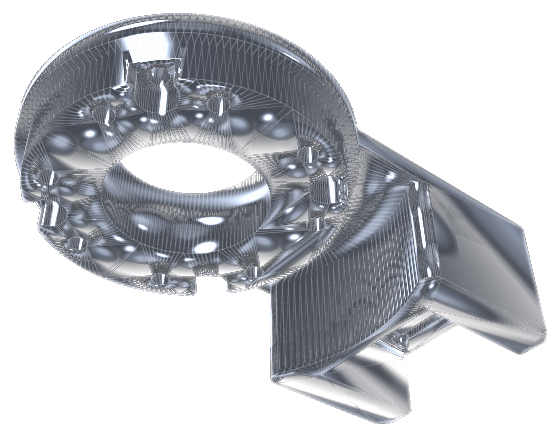
After importing you generally obtain something like this with all triangles in the same group
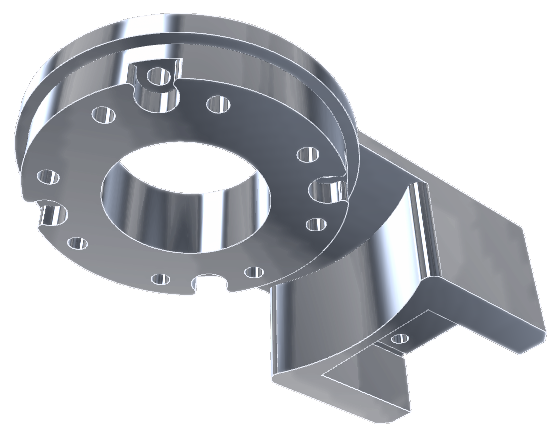
A segmentation will find what to group and give you this
Parameters:
| Name | Type | Description | Default |
|---|---|---|---|
tolerance
|
float
|
maximum difference factor between curvatures of a same group (1 means +100% curvature is allowed) |
5
|
sharp
|
float
|
angle above which an angle is always sharp (radians) |
0.2
|
NOTE
This functions is not magic and despite the default parameters are usually fine for mechanical parts, you may get badly grouped faces in some cases, hence you will need to tune the parameters.
The success of this functions is highly dependent of the quality of the input mesh triangulation.
Examples:
>>> part = read('myfile.stl')
>>> part.mergeclose()
>>> part = segmentation(part)
Source code in madcad/reverse.py
17 18 19 20 21 22 23 24 25 26 27 28 29 30 31 32 33 34 35 36 37 38 39 40 41 42 43 44 45 46 47 48 49 50 51 52 53 54 55 56 57 58 59 60 61 62 63 64 65 66 67 68 69 70 71 72 73 74 75 76 77 78 79 80 81 82 83 84 85 86 87 88 89 90 91 92 93 94 95 96 97 98 99 100 101 102 103 104 105 106 107 108 109 110 111 112 113 114 115 116 117 118 119 120 121 122 123 124 125 126 127 128 129 130 131 132 133 134 135 136 137 138 139 140 141 142 143 144 145 146 147 | |
guesssurface(surface, precision=1e-05, attempt=False)

Guess the surface kind, returns its parameters.
Return a tuple ('surface_type', parameters)
Parameters:
| Name | Type | Description | Default |
|---|---|---|---|
surface
|
Mesh
|
mesh from which to find the surface kind |
required |
precision
|
float
|
typical distance error from mesh to ideal surface in the surface regression |
1e-05
|
attempt
|
bool
|
if True, will not raise an error if the acheived error is too big |
False
|
Source code in madcad/reverse.py
185 186 187 188 189 190 191 192 193 194 195 196 197 198 199 200 201 202 203 204 205 206 207 208 209 210 211 212 213 214 215 216 217 218 219 220 221 222 223 224 225 226 227 228 229 230 231 232 233 234 235 236 237 238 239 240 241 242 243 244 245 246 247 248 249 250 251 252 253 254 255 256 257 258 259 260 261 262 263 264 265 266 267 268 269 270 271 272 273 274 275 276 277 278 279 280 281 282 283 284 285 286 287 288 289 290 291 292 293 294 295 296 | |
guessjoint(solid1, solid2, surface1, surface2, guess=quat(), precision=1e-05)

Create a kinematic joint based on the surfaces given. The function will use guesssurface to find the surface kind and then deduce the appropriate joint to make the surfaces coincide.
Parameters:
| Name | Type | Description | Default |
|---|---|---|---|
solid1, solid2
|
solids the joint applies on |
required | |
surface1, surface2
|
the surface to retreive the joint definition from |
required | |
guess
|
(quat, mat3)
|
orientation tip to orient properly the joint axis, if there is |
quat()
|
precision
|
float
|
precision for |
1e-05
|
Source code in madcad/reverse.py
153 154 155 156 157 158 159 160 161 162 163 164 165 166 167 168 169 170 171 172 173 174 175 176 177 178 179 180 181 | |